Decarbonization Turns Into Competitive Edge at Net Zero Carbon Summit Romania 2026
The fifth edition of the Net Zero Carbon Summit Romania, organized by GOVNET Romania in Bucharest, highlighted a decisive shift in the business landscape: sustainability has moved beyond branding and compliance to become a measurable driver of competitiveness and financial performance.
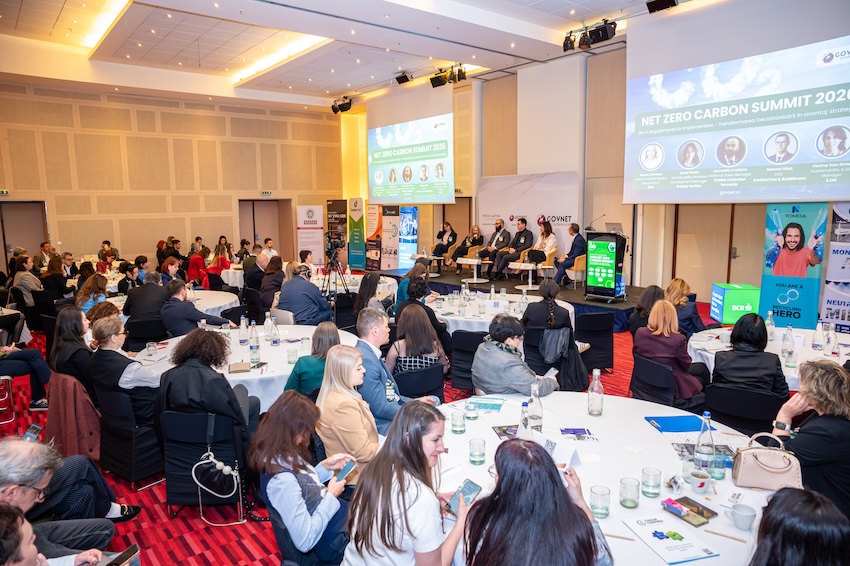
Bringing together leaders from energy, industry, financial services, consulting, and technology, the event delivered a clear message—companies that fail to implement concrete decarbonization strategies risk falling behind in an increasingly regulated and capital-constrained environment.
The 2026 edition also marked a milestone as the first carbon-neutral summit, with emissions generated by the event fully offset—an example of aligning action with message.
From Commitments to Measurable Impact
Opening the event, Adrian Ion, General Manager of GOVNET Romania, emphasized how the market has evolved beyond high-level commitments: “This year’s theme clearly reflects the market’s maturity — we are talking about data, methodologies, financing and, above all, quantifiable results. It is no longer about intentions, but about concrete outcomes: the shift from commitments to implementation, from strategy to measurable impact.”
This shift was echoed throughout the first session, which focused on the foundations of credible decarbonization: data, methodology, and regulation.
A Market Still Lagging Behind
A key concern raised during the summit is that nearly 70% of Romanian companies still lack a concrete decarbonization plan.
According to Monica Movileanu of PwC Romania, the global decarbonization rate has slowed for the first time in a decade: “What we must not do is nothing — at least the short-term actions within reach must be taken now. If we remain at the level of discussions and too few concrete actions, we are heading towards a global temperature increase of between 2.5 and 2.9 degrees Celsius.”
She outlined a structured, step-by-step approach to transition planning, stressing the urgency of moving from analysis to execution.
Strategy vs. Transition: A Critical Distinction
Gabriela Fiștiș, Founder of Bluesid Consulting, highlighted a key misunderstanding still present in many organizations: “Sustainability does not mean ESG — they are two different terms. Sustainability is about impact on the community. ESG is about money, risks, and opportunities. A top manager must have a clear vision of both, because everything under the Green Deal umbrella addresses both — interconnected, but never conflated.”
She stressed that real transformation requires not just commitments, but detailed transition plans with clear investments and timelines.
Data as a Strategic Asset
Technology and data management are becoming central to decarbonization efforts. Oana Vilceanu from Stratos Management underlined that companies often focus too much on data collection: “Sustainability should no longer be seen as just a cost. If we don’t allocate costs today, it is likely to cost us far more in the near future. What we want is to measure, analyze, and make informed decisions — not just report.”
Meanwhile, Laura-Cristina Popescu of Artrom Steel Tubes warned about upcoming changes in Scope 3 reporting: “Scope 3 will no longer be a one-off calculation exercise. It will need to become a continuous system for generating and improving data. The challenge will no longer be how to calculate it once, but how to build a system that consistently produces coherent and increasingly accurate data.”
Regulation and AI Accelerate the Transition
Regulatory pressure is increasing rapidly, particularly with mechanisms such as CBAM and new EU requirements.
Casiana Fometescu, CEO of Carbon Expert, highlighted the role of AI in transforming emissions management: “Management will know in real time — through high-performance AI software — what the energy and gas consumption is, everything happening in operations, right now. No more spending days on calculations. This is clearly the future.”
ESG: From Compliance to Financial Imperative
The second session focused on financing and execution, where ESG is increasingly shaping business decisions.
Ioana Voinescu from BCR emphasized the dual role of ESG: “ESG has become a risk measurement tool. Each of us looks at our own operations and assesses transition risks, physical climate risks, the impact of future regulations. And at the same time, ESG is also a business accelerator — we have seen many new businesses in recent years that are profitable and come directly from ESG integration.”
Certification frameworks are also driving change. Daria Perde from Bureau Veritas Romania noted: “The EcoVadis score is not the end goal. It is the trigger that compels organizations to move from declarative commitments to measurable actions. The market is increasingly penalizing inaction in explicit and direct ways — missed contracts, lost partnerships, restricted access to green finance.”
Sector-Level Transformation Already Underway
In real estate, Răzvan Nica of BuildGreen pointed to tangible benefits: “A green building, beyond the reputational and reporting advantages, delivers concrete competitive benefits in terms of operating costs. Moving from compliance to performance means sustainability becomes a genuine, measurable market differentiator.”
In the circular economy, Laurențiu Croitoru from TOMRA Collection Romania highlighted the scale of impact: “Through TOMRA’s technology infrastructure, we prevent over 1.8 million tonnes of CO₂ emissions annually at a global level. Our ambition is to grow the number of collected units from 50 billion to 130 billion per year — that is decarbonization at scale.”
Meanwhile, Florina Van Strien from E.ON Romania emphasized affordability: “It is important to take steps and embrace emerging technologies, but we must always keep the lens on the cost of transition. Decarbonization does not end with emissions reduction — it also manifests in energy efficiency and lower costs.”
Execution Will Define Market Leaders
The overarching conclusion of the Net Zero Carbon Summit Romania 2026 is clear: decarbonization is no longer optional—it is a business imperative.
Companies that act now will secure competitive advantages, improved access to financing, and stronger market positioning. Those that delay risk higher costs, regulatory pressure, and lost opportunities.
As the transition accelerates, the gap between leaders and laggards will be defined not by ambition, but by execution.