Coface study shows the number of insolvencies in Romania increased by 3.84 percent in 2025 compared to 2024
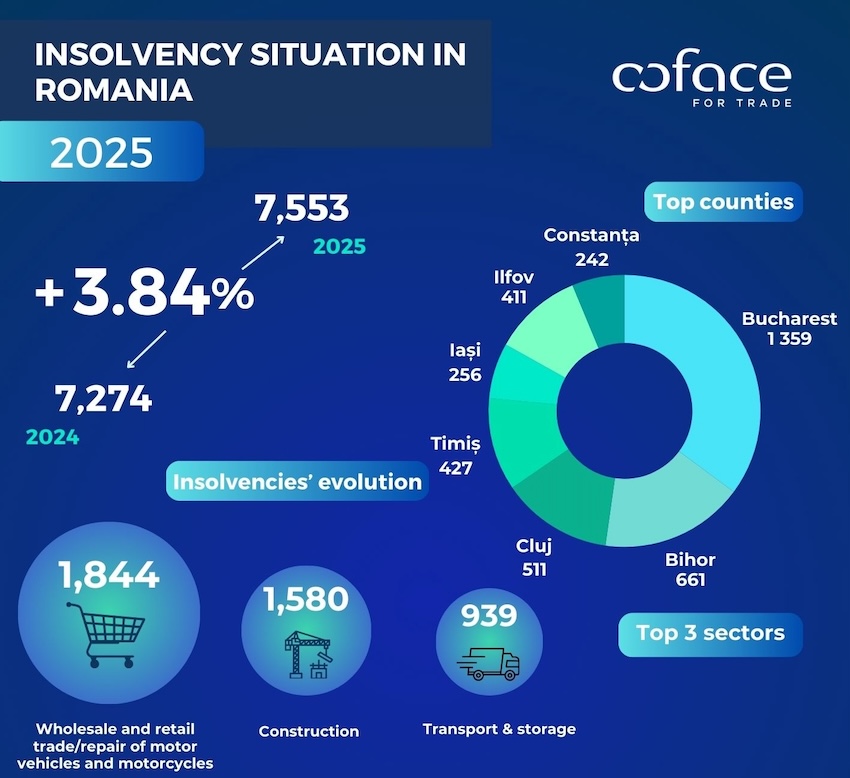
The latest study conducted by Coface Romania shows that in 2025, 7,553 new insolvency proceedings were opened, compared to 7,274 in 2024. Last year, 221 preventive agreement procedures were opened, compared to 96 such procedures opened in 2024. The wholesale and retail trade/repair of motor vehicles and motorcycles sector reported the highest number of insolvencies, namely 1,844, down 4% from the previous year.
Economic context – 2025, a year of global instability
Internationally, the economy was influenced last year by two military conflicts: the war in Ukraine and the HAMAS attack on Israel, with geopolitical factors contributing to the economic downturn in the European Union, particularly in Germany. The international context also had a significant impact on Romania's economy, given that the main destinations for Romanian exports are concentrated in the European Union, with Germany being the most important trading partner, accounting for over 20% of total exports.
Additional pressure on Romania's economy came from the government's commitment to reduce the budget deficit. Romania ended 2025 with economic growth of only 0.6%, an estimated budget deficit of 8.2% (9.3% in 2024) according to ESA methodology, an inflation rate of 9.7% (December 2025), and a government debt ratio that exceeded 60% of GDP for the first time.
"Overall, the domestic business environment faced many challenges in 2025, the most important being the decline in demand, the increase in operating costs, and the new fiscal measures implemented starting in August 2025. In 2026, we expect a deterioration in payment behavior and a continuation of the upward trend in the number of insolvencies. In such a context, effective risk management and robust financial governance become determining factors in avoiding operational bottlenecks and maintaining financial stability," said Alina Popa, Country Manager Coface Romania.
The evolution of insolvent companies
The top three sectors in terms of the number of companies that entered into insolvency last year are wholesale and retail trade/repair of motor vehicles and motorcycles (1,844), Construction (1,580), and Transport and storage (939), accounting for approximately 58% of the total number of insolvencies recorded in 2025.
It is important to note that four of the top seven sectors with the most insolvencies are also among the top seven sectors in terms of the number of insolvencies per 1,000 active companies (construction, manufacturing, hotels and restaurants, and transport and storage). The number of insolvent large companies, those with a turnover of more than EUR 0.5 million in 2024, is also at its highest level in the last seven years, namely 684 (2025) vs. 610 (2024).
"The data reveals an upward trend in the number of companies opting to open preventive concordat procedures. For example, in 2025, 221 such proceedings were opened, compared to 96 in 2024 and 61 preventive concordat proceedings opened in 2023. There is also a high proportion, approximately 22%, of companies that have entered into insolvency and were established before 2010. This, combined with the fact that 2025 saw the highest number of registrations (153,425), suggests structural changes in the economy," added Tiberiu Chesoi, Head of Claims Department at Coface Romania.
After a historic low in 2021, the trend in total amounts refused for payment reversed. Thus, in 2025, the strong growth observed in 2024 continued, reaching a level of RON 3.5 billion, the highest in the last seven years. The number of refused payment instruments increased by 12% compared to 2024 but remained below the level recorded in 2019, reaching 43,600.
Sectoral developments and territorial distribution of insolvencies
Sectoral developments in 2025 were mainly determined by the inflection point reached by the Romanian economy's growth model (the transition from economic growth fueled by unsustainable fiscal stimulus to economic growth shaped by rationalization of government consumption and investment), the fiscal consolidation process, the payment behaviour of the Romanian State, but also by the financing cost of domestic corporations, which remains high and largely conditioned by the level of inflation (the highest in the European Union).
"The risk of insolvency has increased significantly for those sectors where liquidity is particularly dependent on the payment behavior of the Romanian state, and here we refer in particular to construction, but also for those sectors that depend on private consumption, which has been negatively affected both financially (see the evolution of real wages in the second half of 2025) and in terms of confidence in the future.
Alongside these segments, which account for approximately 70% of Romania's GDP, I believe it is relevant to highlight the developments in agriculture, where the benefits of the 2025 agricultural year were unable to offset—for certain players—the difficulties accumulated in 2022-2024, as well as the still negative developments in Industry, impacted by systemic factors such as the sluggish economic growth in Germany and the high cost of electricity," stated Bogdan Nichișoiu, Regional (Central & Eastern Europe) Enhanced Information Manager.
Most of the insolvencies opened in 2025 were recorded in Bucharest (1,359) and in the counties of Bihor (661) and Cluj (511). Of the 7,553 insolvencies opened in 2025, Bucharest continues to account for the largest share (18%). The capital also attracts the most registrations (22% of the total), followed by Ilfov, Cluj, and Timiș. Bucharest continues to generate the most business closures, followed by Cluj, Constanța, and Bihor.
An overview of the local business environment
The business environment in Romania remains dynamic, characterized by a high capacity for regeneration. Despite the increase in the number of dissolutions and suspensions in recent years, which indicates constant pressure, especially on small and medium-sized companies, a high e rate of registrations is maintained, confirming the entrepreneurial potential.
Of the more than 1.29 million legally active companies, approximately 100,000 are limited liability companies (LLC), and 450,244 are sole proprietorships (SP). The number of companies deregistered in 2025 was 83,233, close to the same level as in 2024. In 2025, there was a 23% increase in the number of established companies compared to the previous year, and a 22% increase in dissolutions.
In 2026, Romania's economic growth will continue to be affected by high inflation, restrictive fiscal policy, declining private consumption, and, last but not least, geopolitical factors, all of which will impact the local business environment.
This study considered newly opened insolvencies, based on data published by the ONRC (National Trade Register Office). The analysis of financial indicators for the companies considered was based exclusively on financial statements submitted to the MFP during the period analyzed, based on data processed by Coface.
Study conducted in February 2026.